Coming this summer
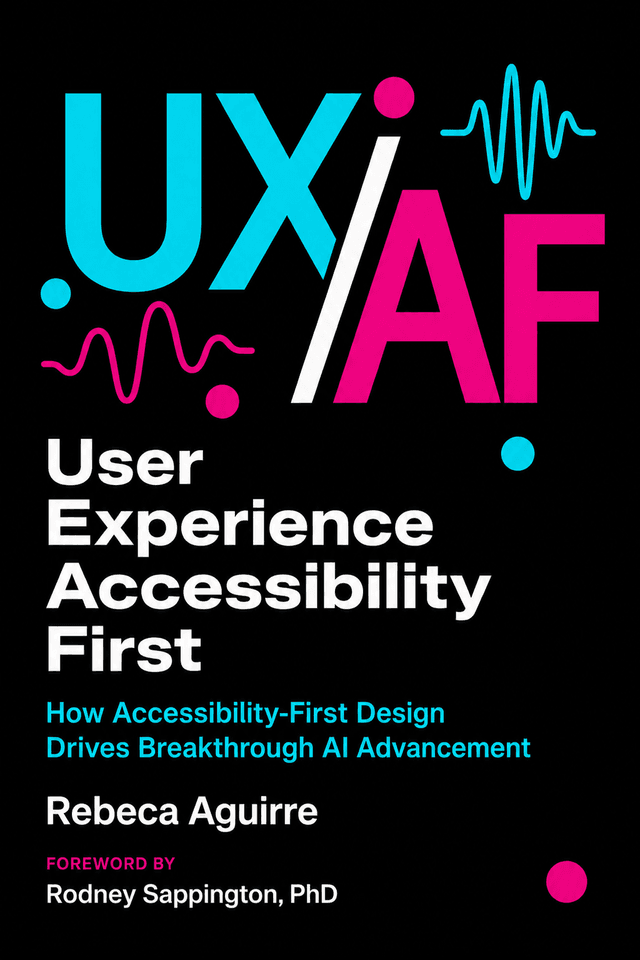
UXAF: User Experience Accessibility First
How Accessibility-First Design Drives Breakthrough AI Advancement
Human variance is the stress test that produces capability. UXAF maps five domains of human variance and shows how building from their constraints produces stronger AI, clearer product logic, and more durable infrastructure.
Nuance: $19.7 billion. SwiftKey: $250 million. The pattern is clear: companies that develop with disability constraints first discover capabilities worth billions when they scale.
- By
- Rebeca Aguirre
- Foreword by
- Dr. Rodney Sappington
- Edited by
- Antonio C. White
The methodology
Five domains of human variance
Each domain is a constraint set that stress-tests system capability. Build from these constraints and you produce products that hold up at scale.
Hearing
Audio-first systems exclude hearing users and produce brittle AI. Building for auditory variance creates notification architecture that works in loud environments, silent contexts, and multi-modal pipelines.
Vision
Screen-reader-compatible systems are not accommodations — they are robust interface logic. Vision-first constraints produce interfaces that hold up under every attention state and rendering condition.
Mobility
Keyboard and switch-access navigation defines the control surface every product should expose. Mobility constraints are the baseline for power users, mobile users, and one-handed contexts.
Cognition
Cognitive variance reveals where systems offload work onto users instead of doing it themselves. Plain-language prompts and recoverable actions reduce error rates for every user under stress, distraction, or time pressure.
Speech
Adaptive voice recognition built for atypical speech is the same capability that improves accuracy for accented speakers, elderly users, and fatigued input — across billions of devices.
What's inside
The pattern behind the acquisitions
Why Nuance and SwiftKey both trace back to disability-first development, and what that means for the next wave of AI.
The Curb Cut Effect, made intentional
The curb cut effect is an observed phenomenon. UXAF is the methodology that makes it repeatable. Here's how to apply it deliberately.
Disabled users as AI training signal
People who navigate at the edges of system design operate at the boundary of system capability. That's not an edge case. It's the most valuable signal in your training data.
The UXAF methodology in practice
A framework for building accessibility into the structural layer: before the interface, before the sprint, before the feature set.