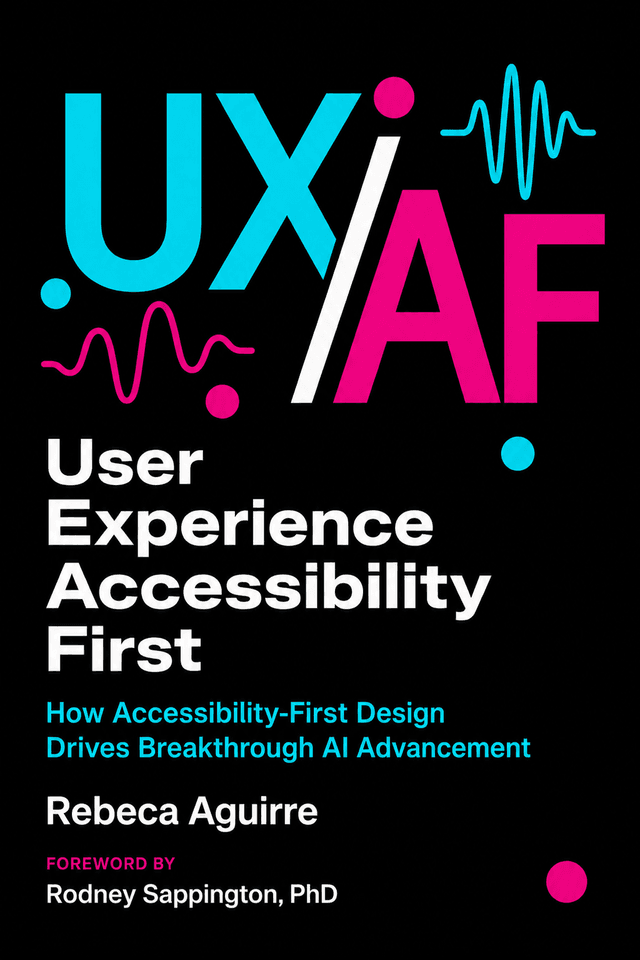
Coming soon
UXAF: User Experience Accessibility First
How Accessibility-First Design Drives Breakthrough AI Advancement
Human variance is the stress test that produces capability. UXAF shows how accessibility-first design creates stronger AI systems, clearer product logic, and more durable digital infrastructure. The pattern is visible across technology history: voice systems, predictive text, speech interfaces, and multimodal tools often gain power when they are shaped by people whose signals reveal what standard systems miss. This book gives founders, product teams, and accessibility leaders a practical methodology for building from that insight.
DECTalk to Nuance: $19.7 billion. SwiftKey: $250 million. ElevenLabs: $6.6 billion. The pattern is clear: companies that develop for disability constraints first discover capabilities worth billions when they scale.
- Editor:
- Antonio C. White
- Foreword:
- Dr. Rodney Sappington
Join the list
Join the list for book updates, UXAF essays, and practical tools for accessibility from inception.
Occasional updates. Clear writing. No noise.
What's inside
The pattern behind the acquisitions
Why Nuance, SwiftKey, and ElevenLabs all trace back to disability-first development, and what that means for the next wave of AI.
The Curb Cut Effect, made intentional
The curb cut effect is an observed phenomenon. UXAF is the methodology that makes it repeatable. Here's how to apply it deliberately.
Disabled users as AI training signal
People who navigate at the edges of system design operate at the boundary of system capability. That's not an edge case. It's the most valuable signal in your training data.
The UXAF methodology in practice
A framework for building accessibility into the structural layer: before the interface, before the sprint, before the feature set.